Termite baits are designed to control the colony behind a subterranean termite infestation, rather than simply killing the termites visible around a damaged door frame, skirting board or mud shelter tube.
Worker subterranean termites continuously search for cellulose food sources. When they encounter a termite bait station, they feed on the bait and continue moving through their established foraging network. Because the treatment is deliberately slow acting, its effect can extend beyond the termites feeding directly at the station and progressively interfere with the activity required to sustain the colony. Termite baiting is recognised as an established termite-control approach alongside soil-applied termiticides and other treatments.
This distinction is important because subterranean termites can remain concealed in soil, wall cavities, structural joints and other hidden spaces while workers travel into a property to reach timber and other cellulose materials. By the time visible signs appear, the termites a property owner can see may represent only a small portion of the active infestation.
For homeowners, facility managers and business operators in Singapore, termite baiting is therefore better understood as a managed colony-control programme rather than a one-time treatment. Inspection, correct termite identification, strategic station placement, feeding, monitoring and follow-up all influence the outcome.
Aardwolf Pestkare uses termite baiting alongside soil treatment, spot treatment, species-specific termite management and TermiCam thermal imaging where appropriate. Its published termite approach reflects a broader principle that is increasingly important in professional pest management: identify the pest and site conditions first, then select the control method that fits the actual infestation.
Quick Answer: How Do Termite Baits Work?
Termite baits work by providing worker subterranean termites with a cellulose food source containing a slow-acting treatment. Workers discover the bait while foraging, continue feeding and remain active within their colony network while the treatment gradually takes effect. As exposure continues, the worker population and the colony functions that depend on it become increasingly disrupted.
Unlike spraying only the termites visible at the surface, baiting is intended to influence the hidden infestation sustaining that activity. Aardwolf states that termite baiting commonly takes several weeks to a few months, depending on factors such as colony size, station placement, feeding activity and how quickly termites discover the bait.
This gradual process is intentional. The objective is not an immediate pile of dead termites beside the station, but a progressive reduction in the colony’s ability to continue normal activity.
What Are Termite Baits?
Termite baits are controlled feeding systems used mainly for subterranean termite management. A bait station provides a cellulose-based food source that worker termites can discover as part of their normal search for food.
Cellulose matters because termites naturally consume plant-based material, including wood. Instead of relying only on a treatment that termites encounter while crossing a surface, baiting uses their own foraging behaviour as part of the control process.
The active treatment is deliberately slow acting. This gives workers an opportunity to continue feeding and remaining within their established network before the treatment affects them. Aardwolf describes its baiting approach as targeting the colony rather than only the termites that happen to be visible around an infested area.
The important question for a property owner is therefore not simply whether termite baits work. It is whether baiting is appropriate for the termite species, level of activity and building conditions found at the property.
How Do Termite Baits Affect an Entire Subterranean Colony?
The process begins with worker termites discovering the bait during normal foraging. This discovery stage is critical because a station that termites never encounter cannot influence the active colony.
Once workers begin feeding, the delayed nature of the treatment allows termite activity to continue for a period of time. Workers still move through their established routes while the bait gradually begins to affect the population.
This matters because workers perform essential functions within a subterranean termite colony. They search for food, maintain foraging routes and support other colony members. As the worker population becomes progressively affected, the colony becomes increasingly unable to maintain the activity required for long-term survival.
The expected result is therefore a progressive weakening of the infestation rather than an instant disappearance of every termite. Feeding can decline, fresh mud tubes or other signs may become less common, and technicians can use repeated monitoring to determine whether the active colony is continuing to function.
Professional monitoring is an important part of this process. Aardwolf’s published baiting approach includes checking stations and continuing treatment as colony activity changes rather than treating station installation as the end of the programme.
Why Do Termite Baits Need to Work Slowly?
Slow action is central to the logic of colony-focused baiting.
If termites were killed immediately after feeding, the effect would remain concentrated around the bait station. A delayed treatment gives worker termites more opportunity to continue their normal feeding and movement before the treatment takes effect.
This explains something that can initially confuse property owners: termites may still be visible or actively feeding during the early stages of baiting.
That does not automatically mean the programme has failed.
The more meaningful question is whether termite activity changes over the monitoring period. Aardwolf describes baiting as a process that may require several weeks or months rather than an immediate knockdown treatment.
For this reason, a professional baiting programme should be judged by changes in activity, bait consumption and fresh signs of infestation rather than by what happens during the first few days.
Does Termite Bait Kill the Queen?
Termite baiting is designed to achieve colony-level control, but it is more accurate to explain the process in terms of colony disruption than to assume that one worker simply carries poison directly to the queen.
A subterranean termite colony depends heavily on its workers. They forage, maintain routes and perform many of the activities needed to support the rest of the colony.
As the worker population becomes progressively disrupted, the colony becomes less capable of sustaining those functions. The objective is therefore not to physically locate the queen and treat her individually, but to interfere with the colony system sufficiently that the infestation can no longer maintain itself.
This is a more defensible explanation of how colony control occurs than presenting baiting as a simple one-step transfer from a worker to a queen.
What Happens During a Termite Baiting Programme?
A professional baiting programme should begin with inspection rather than immediately installing stations.
The technician first needs to determine whether termites are present, identify the likely species or termite group and understand where activity appears to be concentrated. Visible mud tubes, damaged timber, moisture conditions and the relationship between the affected area and surrounding building structure can all help guide this assessment.
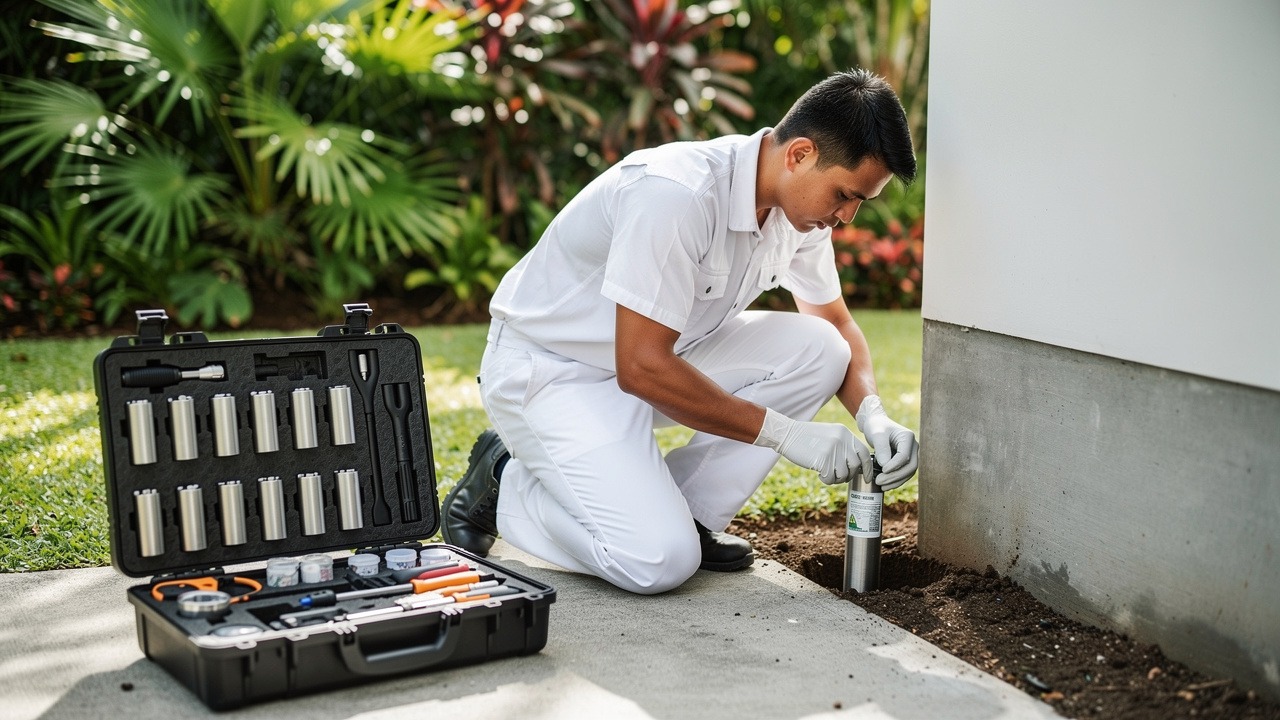
If subterranean termite activity is identified and baiting is considered appropriate, stations are positioned where workers are active or reasonably likely to encounter them. Aardwolf states that its termite baiting stations are strategically placed around areas where activity has been detected.
The next stage is discovery. Termites have to encounter and begin feeding on the bait, so there may be little immediate visual change after installation.
Once feeding begins, the colony-exposure stage develops gradually. Workers continue consuming bait while the slow-acting treatment begins affecting termite activity.
Monitoring then becomes essential. Technicians assess whether workers are feeding, whether additional bait is required and whether fresh evidence of termite activity is decreasing.
When the original colony activity has declined sufficiently, the emphasis shifts toward continued monitoring and prevention. Aardwolf’s published subterranean termite guidance recommends ongoing inspection even after treatment because future termite activity can still develop.
Where Are Termite Bait Stations Installed: Indoors or Outdoors?
Termite bait stations can be positioned differently depending on the treatment system, the location of termite activity and the layout of the property.
Some systems use stations around suitable exterior or perimeter areas where subterranean termites may be foraging through soil. Other bait systems or treatment configurations may be positioned closer to identified termite activity.
Aardwolf describes bait stations as being strategically positioned around buildings and detected termite activity rather than following one universal placement pattern. Its emergency termite guidance similarly refers to stations being positioned around the property perimeter or near termite activity.
This means homeowners should not assume that more stations automatically produce better control. The important issue is whether the placement is based on where termites are active and where they are likely to encounter the bait.
A professional should therefore be able to explain why each treatment area has been selected and how the station placement relates to the findings from the inspection.
What Does Aardwolf Look for Before Recommending Termite Baiting?
Based on Aardwolf’s published termite service information, the decision should begin with determining what termite is present and where the infestation is active rather than automatically recommending baiting for every case.
Subterranean termite activity is particularly relevant because these termites forage outside the colony and can encounter bait stations along their feeding network. Drywood termites behave differently because they can establish colonies directly inside timber without maintaining the same soil-connected foraging system.
The property layout also matters. Areas of active feeding, likely entry routes, moisture, accessible soil and the location of damaged timber can affect which treatment approach is practical.
Where baiting is appropriate, the programme can target active colony feeding. Where broader soil protection is relevant, soil treatment may be considered. Where activity is localised, targeted treatment may be more suitable. Drywood termite infestations require a different approach to subterranean baiting.
This is why Aardwolf provides several termite-control methods rather than treating bait stations as a universal answer.
Why Is Spraying Visible Termites Different From Colony Baiting?
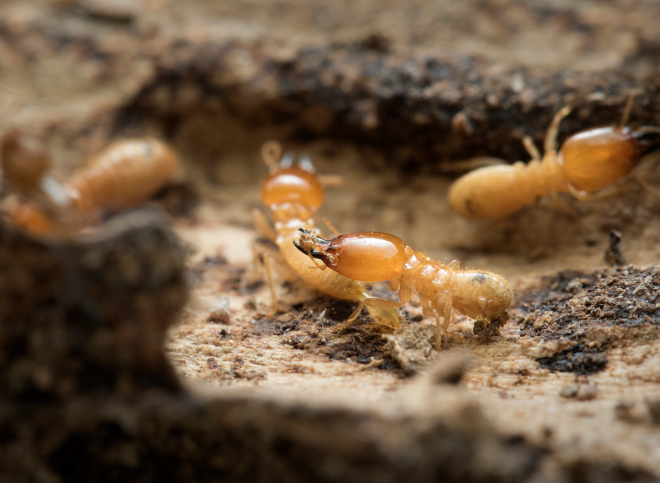
Spraying termites that are visible may kill the insects exposed at that moment, but these termites can represent only a small portion of a subterranean infestation.
The main colony may remain hidden underground or in concealed building areas while other termites continue travelling through protected routes.
Disturbing an active mud shelter tube or spraying the area can also change termite behaviour around that location. The active route that could have helped a technician understand how termites are moving may become less useful for inspection.
For this reason, Aardwolf advises property owners who encounter active termite activity to avoid unnecessary disturbance before professional assessment.
Photographing the affected area and arranging an inspection can therefore provide more useful information than immediately focusing on the insects that are visible.
Which Types of Termites Can Be Controlled With Bait?
Correct termite identification should come before treatment selection because different termite groups do not behave in the same way.
Subterranean termites are the main termite group associated with colony baiting. They maintain a relationship with soil and send workers outward to forage for cellulose food sources.
These workers commonly travel through mud shelter tubes, which help protect them as they move between the colony and food sources. Tubes may appear along walls, skirting boards, foundations, pipe areas, built-in fittings and other structural routes.
Because subterranean workers actively forage beyond the main colony, strategically positioned bait can become part of their feeding network.
Drywood termites behave differently. They can establish colonies within relatively dry timber and do not depend on the same soil-connected foraging behaviour. Aardwolf states that drywood termite infestations require different treatment approaches from subterranean baiting, including direct treatment of affected timber where appropriate.
Dampwood termites are more closely associated with high-moisture or decaying timber and also need to be assessed according to their own habitat and behaviour.
Finding damaged wood alone therefore does not prove that termite baiting is the correct treatment. Species identification remains a critical first step.
What Signs Suggest Subterranean Termite Activity?
Mud shelter tubes are among the most recognisable signs of subterranean termites. These protected routes allow termites to move between soil and food sources while remaining sheltered from exposed conditions.
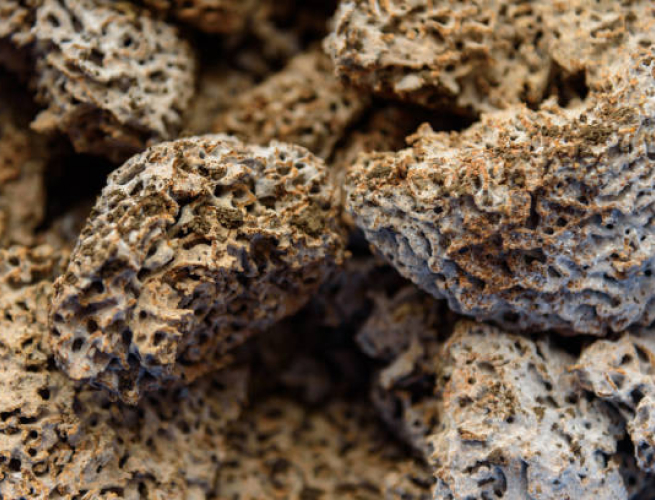
Hollow-sounding timber can also indicate internal damage. Termites may consume the inside of a wooden component while leaving a thin external surface relatively intact, meaning a door frame, skirting board or built-in cabinet can look normal until damage becomes more advanced.
Discarded wings may indicate termite swarming, while weakened timber, damaged built-ins, bubbling finishes and live pale-coloured termites can also justify an inspection. Aardwolf identifies several of these signs in its current termite guidance.
The appearance of these signs should trigger investigation rather than an automatic choice of treatment. Drywood and subterranean termites can both affect timber but require different management approaches.
How Does a Professional Termite Inspection Work?
A professional termite inspection should examine both the visible evidence and surrounding conditions that could help explain the infestation.
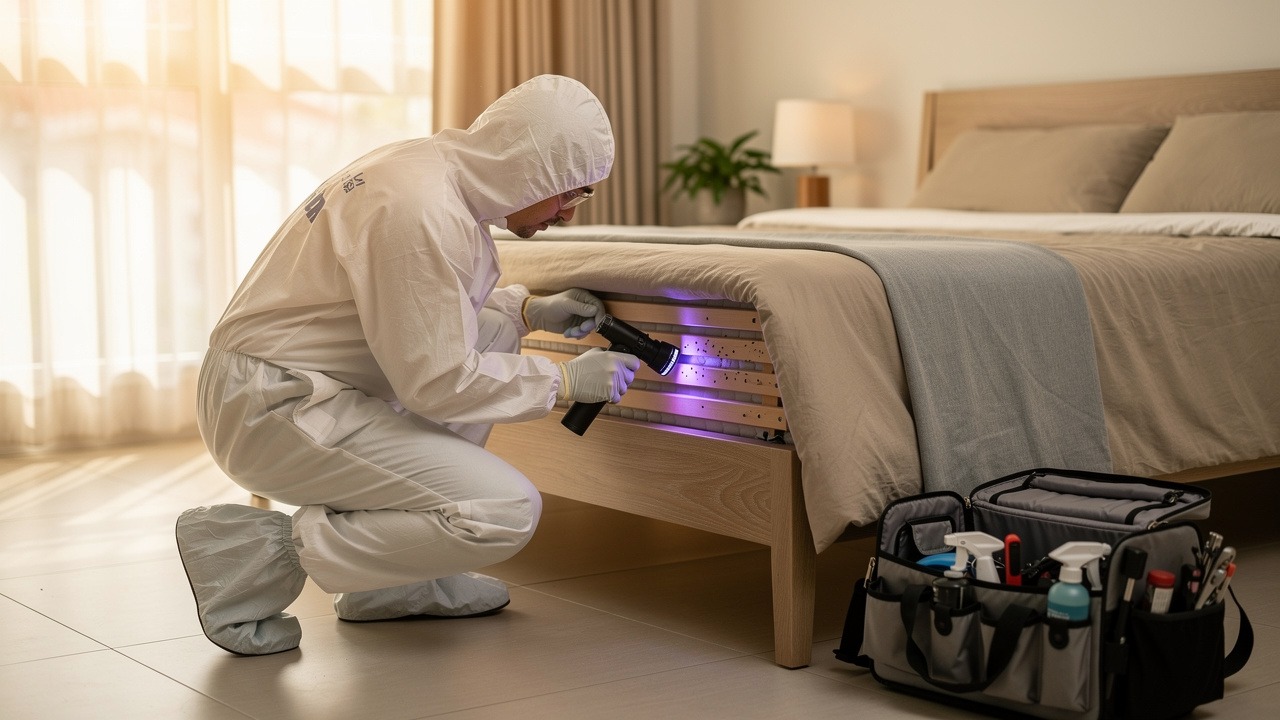
Technicians may inspect skirting boards, door frames, built-in cabinets, wall and floor areas, foundations, wooden fittings, service areas and locations where hidden termite activity is suspected. Aardwolf’s published inspection guidance describes examining structural and timber areas to identify signs of concealed activity.
Not all termite activity can be identified from what is visible on the surface.
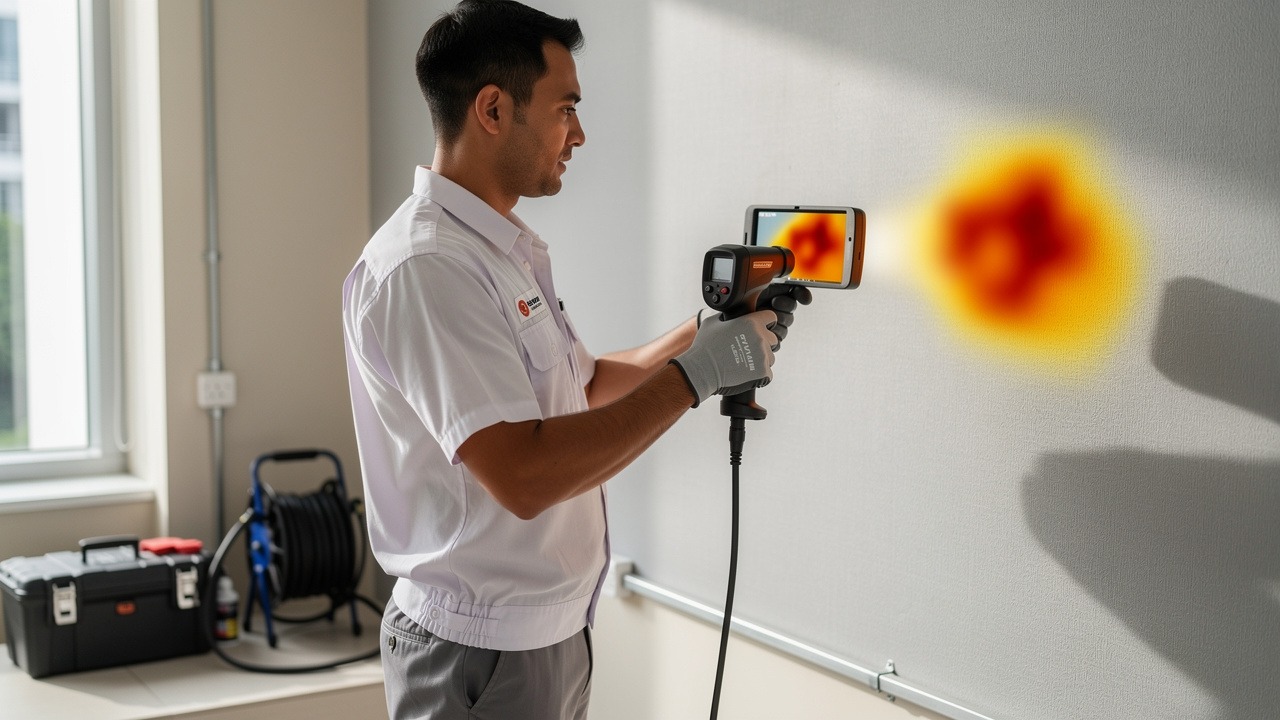
Aardwolf uses TermiCam thermal imaging as an additional inspection tool for subterranean termites. The company states that it began using thermal imaging under a franchise arrangement with TermiCam Australia in 2002 and that its thermographers are trained in Australia and certified by the Australian Institute for Non-Destructive Testing.
Thermal imaging should be understood as a diagnostic aid rather than a replacement for professional assessment. The technician still needs to interpret the inspection findings together with the building conditions, visible evidence and expected termite behaviour.
How Is the Right Termite Treatment Selected?
The treatment should follow the diagnosis.
Baiting may be appropriate where active subterranean termites are feeding and colony-focused control is required. Soil treatment has a different role because it involves treating suitable soil areas to create a zone that termites encounter when approaching a structure. EPA guidance recognises both soil-applied barrier treatments and termite baits as established termite-control approaches.
The choice can also depend on the construction of the property, accessible soil, location of termite activity and whether the infestation is concentrated in one area or spread across several routes.
Aardwolf provides termite baiting, soil treatment, spot treatment and species-specific solutions instead of applying a single standard method to every infestation.
This is consistent with the broader direction of Singapore’s SS 721:2025 Integrated Pest Management framework. NEA states that the standard promotes objective pest-risk assessment, prevention and the selection of appropriate pest-control measures, and specifically includes termites within its scope.
For property owners, the practical lesson is simple: the question should not be “Which treatment sounds strongest?” but “Which treatment fits the termite species and conditions found during inspection?”
Is Termite Baiting Better Than Soil Treatment?
Neither method is automatically better because baiting and soil treatment are designed to perform different functions.
Termite baiting relies on worker termites discovering and feeding on treated cellulose. It is therefore closely connected with active subterranean colony behaviour and requires monitoring over time.
Soil treatment works differently. A termiticide is applied to suitable soil around or beneath relevant parts of a structure to establish a treated zone. EPA guidance describes soil-applied barrier treatment as one of the standard techniques used against termites.
The building itself can determine what is practical. A property with accessible soil around likely entry routes may have different treatment options from a building where soil access is limited.
In some situations, more than one method can form part of the pest-management strategy. Aardwolf provides both baiting and soil treatment rather than describing either method as universally superior.
The better comparison is therefore based on infestation type, property layout, accessibility, treatment objective and professional inspection findings.
Are Termite Baits Safe for Homes With Children or Pets?
The safety of a termite bait system should be assessed according to the specific product and installation rather than answered with a blanket statement that every bait is automatically safe.
Different systems can use different active ingredients, station designs and placement methods. Product instructions and approved label directions therefore matter.
EPA guidance similarly advises consumers to ensure that termite-control products are appropriately registered for their intended use and applied according to product directions.
If children or pets use the property, this should be discussed with the pest-management provider before treatment begins.
A property owner can ask what bait system will be used, what active ingredient it contains, where stations will be positioned, whether the stations could be accessed accidentally and what precautions apply to the particular product.
This approach provides a more useful safety assessment than relying on a generic statement that all termite baiting is harmless in every environment.
How Long Does Termite Baiting Take in Singapore?
Termite baiting should not be expected to eliminate colony activity immediately.
Aardwolf states that baiting can take several weeks to a few months, with the timeframe influenced by colony size, termite activity, feeding and station placement.
The early stages may involve workers discovering the stations and establishing feeding. Termites may therefore remain visibly active while the programme is progressing.
Instead of judging success based only on the first few days, property owners should look at how the infestation changes during monitoring.
Whether termites are feeding, whether bait consumption changes and whether fresh evidence of activity continues to appear are more useful indicators of progress.
This is also why follow-up technician visits form an important part of a professional baiting programme.
Are Termite Baits Suitable for Homes, Shops and Commercial Properties?
Termite baiting can be used across residential, commercial and industrial properties when the termite species and property conditions make the method appropriate.
In homes, activity may occur around skirting boards, door frames, cupboards, built-in cabinetry, storerooms and other timber elements.
Commercial properties may also have timber fittings, partitions, storage areas, service spaces and structural locations that are vulnerable to subterranean termite activity.
For businesses that need to remain operational, a strategically managed baiting programme can sometimes provide a more targeted treatment approach where site conditions make baiting suitable.
Aardwolf currently provides termite baiting and related termite-control services for residential, commercial and industrial customers in Singapore.
The property category alone does not determine the treatment. The termite species and infestation conditions remain the more important considerations.
What Should You Do if You Find a Termite Mud Tube?
If a suspicious mud shelter tube appears, avoid immediately destroying or spraying it.
Leaving the route relatively undisturbed can help preserve useful evidence for the technician. Photographing the area can also document what the activity looked like when it was first discovered.
Nearby timber can be observed for obvious visible damage, and moisture problems such as leaking pipes can be noted, but extensive dismantling should normally wait until the infestation has been assessed.
The next step is to determine whether the activity is caused by subterranean termites or another termite type and where the termites appear to be travelling.
Aardwolf similarly advises against unnecessarily disturbing active termite routes before inspection.
Treatment can then be selected based on the inspection rather than on the assumption that every mud tube requires the same solution.
Can You Install Termite Baits Yourself?
The physical station may appear relatively simple, but an effective baiting programme depends on more than placing bait around a property.
The termite species must first be identified. Suitable placement needs to be selected, and the stations need to be monitored to determine whether workers have discovered them.
Feeding activity can then influence whether bait should be replenished, whether placement should be adjusted and whether another treatment method should be considered.
Aardwolf’s own guidance describes professional monitoring of bait stations as an ongoing part of subterranean termite management rather than a set-and-forget process.
A station that is never discovered by termites cannot meaningfully influence an active colony.
Professional assessment becomes particularly important when the species is uncertain, several areas of a building are affected or damage may involve structural timber.
What Happens After the Termite Colony Is Controlled?
Controlling the active colony is not necessarily the final step in termite management.
Another colony can potentially forage into the property later, and changes in moisture, drainage, stored materials or building conditions can create new favourable areas.
Aardwolf recommends continued monitoring after termite treatment, together with ongoing inspection and maintenance to reduce the risk of reinfestation.
This means the post-treatment stage should focus on whether fresh termite evidence appears, whether vulnerable parts of the property remain favourable to termites and whether preventive maintenance is needed.
Singapore’s SS 721:2025 framework supports the same broader philosophy. NEA describes Integrated Pest Management as involving objective risk assessment, prevention, appropriate control measures and continued performance monitoring rather than relying only on reactive treatment after pests become visible.
Long-term termite management is therefore better understood as an ongoing risk-reduction process rather than a permanent guarantee that another colony can never appear.
Can Termites Return After Baiting?
Yes. Controlling one active subterranean termite colony does not mean the property can never experience termites again.
Another colony may eventually forage into the area, particularly if environmental or building conditions remain favourable.
This is why continued inspection matters after the original treatment programme ends.
The distinction is important when evaluating a termite service. Successful control of an existing colony and permanent prevention of every future termite infestation are not the same claim.
A responsible treatment plan should therefore explain not only how the current infestation will be addressed but also what monitoring or preventive measures may be appropriate afterwards.
How Can You Reduce the Risk of Future Termite Activity?
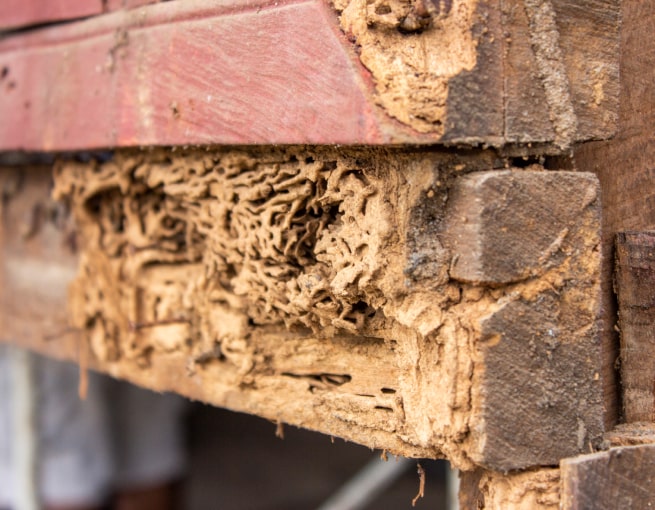
Moisture management is one of the most useful preventive measures because persistent leaks and damp building areas can create conditions favourable to termite activity.
Aardwolf specifically recommends addressing water leaks and drainage problems as part of termite prevention.
Cellulose-rich materials should also be managed carefully. Unused timber, cardboard, paper and similar materials should not be allowed to accumulate unnecessarily in damp areas close to the building.
Where practical, direct wood-to-soil contact should be reduced because it can provide termites with a convenient connection between the soil and a food source.
Cracks and utility penetrations around relevant parts of the building can also be inspected and maintained. EPA termite-prevention guidance similarly recommends reducing openings around foundations and utility services and managing moisture around the structure.
Regular inspection remains important because subterranean termite activity can develop in concealed areas before significant visible timber damage appears.
The earlier activity is identified, the more information a technician has when determining whether baiting, soil treatment or another method is appropriate.
How Does Singapore’s SS 721:2025 Relate to Termite Management?
Singapore Standard SS 721:2025 provides a national framework for the performance of professional pest-management services.
NEA states that the standard promotes objective pest-risk assessment, prevention and appropriate pest-control implementation rather than relying only on reactive treatment. Termites are explicitly included among the pest types covered by the framework.
This is relevant to termite management because there is rarely one method that should automatically be applied to every property.
An integrated approach begins by understanding the infestation and site risk. Treatment can then be selected according to the species and property conditions, followed by monitoring and preventive action.
For a property owner comparing termite-control providers, this provides a useful benchmark: the company should be able to explain what was found, why a treatment is being proposed and how progress will be assessed.
That is more informative than simply being told that a particular chemical or bait system is always the “best” termite solution.
How Does Aardwolf Pestkare Approach Termite Management?
Aardwolf’s termite programme extends beyond baiting alone.
Its current services include termite inspection, TermiCam thermal imaging, subterranean termite baiting, soil treatment, spot treatment and treatment designed for different termite species.
The company was established in Singapore on 8 April 1997.
For subterranean termites, Aardwolf states that it began using TermiCam thermal imaging under a franchise arrangement with TermiCam Australia in 2002. The company also states that its thermographers are trained in Australia and certified by the Australian Institute for Non-Destructive Testing.
The value of this multi-method approach is not that every infestation receives more treatment. It is that the treatment can be selected according to what the inspection finds.
A property with suitable subterranean termite activity may be considered for baiting. Another property may be more suited to soil treatment or targeted intervention, while drywood termite activity requires a different approach.
For the property owner, the underlying principle is straightforward: the termite species and site conditions should determine the treatment, not the other way around.
Frequently Asked Questions About Termite Baits in Singapore
How Do Termite Baits Reach the Colony?
Worker subterranean termites discover the bait while carrying out their normal foraging activity. They consume the treated cellulose and continue moving through their established termite network while the slow-acting treatment progressively affects colony activity. The process is intended to reach beyond the termites visible at the bait station and influence the hidden infestation sustaining them.
Why Do Termite Baits Work Slowly?
Delayed action gives worker termites time to continue feeding and moving through the colony network before treatment takes effect. This is why visible feeding during the early stages of a baiting programme does not automatically mean the treatment has failed. Professional monitoring looks for changes in feeding and fresh activity over time rather than expecting an instant knockdown.
Do Termite Baits Kill the Queen?
The more useful way to understand baiting is as colony-level disruption rather than a direct attempt to locate and individually treat the queen. Workers perform functions needed to sustain the colony, and progressive disruption of that workforce can make the colony unable to continue normal activity.
How Long Does Termite Baiting Take in Singapore?
Aardwolf states that baiting typically requires several weeks to a few months, although actual timing varies with colony size, station placement, feeding levels and other site conditions. Monitoring is therefore important because the progress of the infestation is more meaningful than expecting every termite to disappear within a fixed number of days.
Should I Spray Termites Before an Inspection?
It is generally better to leave suspicious active termite routes relatively undisturbed until they can be assessed. Random spraying may kill visible termites without addressing the hidden colony and may alter activity around the original route. Photographing the evidence and arranging an inspection gives the technician more information about where termites were active.
Do Termite Baits Work on Drywood Termites?
Subterranean termite baiting should not automatically be applied to drywood termites. Drywood termites establish colonies within timber and do not depend on the same soil-connected foraging network. Aardwolf describes direct treatment of affected timber as part of its drywood termite approach, which is why species identification should come before treatment selection.
Are Termite Bait Stations Installed Inside or Outside the Property?
Placement depends on the bait system, infestation and property layout. Stations can be positioned around suitable perimeter areas or near detected termite activity, depending on how the treatment system is designed. The technician should select placement according to likely termite routes rather than following one universal indoor or outdoor rule.
Are Termite Baits Safe Around Children and Pets?
Safety depends on the specific bait system, active ingredient, station design and installation. Property owners should tell the pest-management provider if children or pets use the premises and ask what product will be installed, where stations will be located and what precautions apply. Product instructions and approved use directions should guide treatment.
Is Termite Baiting Better Than Soil Treatment?
Neither approach is universally better. Baiting works through active termite feeding and colony behaviour, while soil treatment creates a treated zone in suitable soil. Property layout, termite species, active entry routes and accessible treatment areas all influence which option is more appropriate. In some situations, different methods can form part of the same overall management strategy.
How Often Should Termite Bait Stations Be Checked?
The correct monitoring schedule depends on the bait system, level of feeding and treatment programme. Professional termite baiting should include scheduled follow-up so technicians can determine whether termites are feeding, whether bait requires replenishment and whether activity is declining.
Can Termites Come Back After a Colony Has Been Controlled?
Yes. Another subterranean termite colony can potentially forage into the property after the original colony has been controlled. Continued inspection, moisture management and maintenance therefore remain important. This prevention-and-monitoring approach is also consistent with Singapore’s SS 721:2025 Integrated Pest Management framework.
What Happens After Termite Baiting Is Completed?
After active colony activity has declined, the property should move into a monitoring and prevention stage. Future inspection can help identify new termite activity, while moisture problems, wood-to-soil contact and other favourable conditions should be addressed where practical. Completing one baiting programme does not remove every future termite risk.
Final Thoughts: Can Termite Baits Eliminate an Entire Colony?
Termite baiting is designed to achieve something that spraying a few visible termites cannot: target the hidden activity sustaining a subterranean termite colony.
The process is deliberately gradual. A professional first identifies the termite and assesses the property before deciding whether baiting is appropriate. Stations are then positioned according to termite activity, workers are allowed to discover and feed on the bait, and the programme is monitored as colony activity changes.
This explains both the strength and the limitation of baiting. It can provide colony-focused treatment for suitable subterranean termite infestations, but it should not automatically be applied to every termite problem.
Drywood termites behave differently and require treatment directed toward affected timber. Some subterranean termite situations may be more suitable for soil treatment, while other properties may benefit from more than one management method.
Singapore’s current SS 721:2025 Integrated Pest Management framework reflects the same underlying principle: assess the pest risk, select appropriate control measures and continue monitoring instead of relying only on reactive treatment after visible activity appears.
Aardwolf Pestkare applies a multi-method approach involving inspection, TermiCam thermal imaging, termite baiting, soil treatment, spot treatment and species-specific management. The company has operated in Singapore since 1997 and states that it has used TermiCam thermal imaging for subterranean termite detection since 2002.
For a property owner who discovers suspicious termite activity, the most useful first action is therefore not simply to kill the termites that can be seen.
The priority is to identify the termite, understand where the infestation is active and choose a treatment that addresses the colony and property conditions behind the visible problem.