A mosquito trap can help reduce mosquito activity around a home or business, but it should not be treated as a complete dengue-control solution.
Singapore’s National Environment Agency (NEA) states that mosquito traps are useful for surveillance and research, and that suitable traps may help reduce biting pressure when deployed widely. However, traps compete with people and natural breeding habitats for mosquitoes’ attention and are likely to capture only a relatively small proportion of the overall mosquito population. NEA therefore identifies source reduction, or the removal of mosquito breeding habitats, as the key measure for reducing mosquito populations and dengue risk.
This distinction is important for anyone searching for a mosquito trap in Singapore. A device may capture adult mosquitoes while a plant tray, drain, roof gutter, pail or other water-holding location nearby continues producing new mosquitoes.
The practical question is therefore not simply which mosquito trap catches the most insects. A useful assessment should consider which mosquito species the trap is designed to attract, what cues it uses, where it will be placed, how it must be maintained and whether breeding sources around the premises are being removed at the same time.
Aardwolf Pestkare approaches mosquito management from this broader perspective. Its mosquito-control services include inspection for breeding locations, larviciding to target mosquito larvae, and fogging or misting for adult mosquito control where appropriate. The company was established in Singapore in 1997 and describes its wider pest-management approach as identifying the pest problem accurately before selecting an appropriate management solution.
Quick Answer: Do Mosquito Traps Work in Singapore?

Mosquito traps can catch mosquitoes, but their effectiveness depends on the trap design, attractant, placement, maintenance and mosquito species being targeted. NEA distinguishes traps that use cues such as carbon dioxide, octenol, colour, light, heat and moisture from passive traps that simply capture mosquitoes flying nearby.
For dengue-related concerns, the most important distinction is that not every trap is equally relevant to Aedes aegypti, Singapore’s primary dengue vector. NEA states that light-based traps are effective mainly for certain night-active mosquitoes and are not effective for capturing predominantly daytime-biting Aedes aegypti.
A mosquito trap should therefore be treated as an additional layer of protection. Removing stagnant water, preventing breeding and reducing mosquito bites remain more important than relying on a trap alone.
How Do Mosquito Traps Work?
Mosquito traps work by either attracting mosquitoes deliberately or capturing mosquitoes that happen to fly close enough to the device.
NEA broadly distinguishes active traps and passive traps. Active traps use visual, olfactory or thermal cues to lure mosquitoes. Passive traps do not use attractants and may instead use a fan or similar mechanism to capture mosquitoes passing nearby.
Active traps can also be divided according to the behaviour they target. Some imitate a host and attract female mosquitoes searching for a blood meal, while others mimic suitable egg-laying sites and attract females preparing to lay eggs.
This distinction is important because a mosquito looking for a human host is responding to different cues from a mosquito searching for somewhere to lay eggs.
The best trap therefore depends on what behaviour the device is designed to exploit rather than simply how bright, large or visually impressive it appears.
What Types of Mosquito Traps Are Used?
Several mosquito-trap designs exist, and they should not be assumed to perform equally against Aedes mosquitoes.
Host-Seeking Mosquito Traps
Host-seeking traps attempt to imitate some of the characteristics mosquitoes use to find people or animals.
NEA identifies carbon dioxide, lactic acid, octenol, light, colour, movement, temperature and moisture as cues that can influence host-seeking mosquitoes. Commercial traps may combine several of these signals rather than relying on one cue alone.
A host-seeking trap can therefore be more sophisticated than a simple electric light. However, the trap still needs to compete with real people, who naturally produce heat, moisture, carbon dioxide and many different odours.
This is one reason even a well-designed trap should not be expected to eliminate all mosquitoes around a property.
CO2 Mosquito Traps
Carbon dioxide is an important host-seeking cue because mosquitoes can detect increased concentrations when searching for a blood meal.
NEA notes that many commercial traps produce carbon dioxide to mimic human exhalation. Depending on the design, carbon dioxide may come from propane combustion, dry ice or cylinders. These systems require appropriate maintenance to remain functional.
Carbon dioxide can make a trap more biologically relevant to host-seeking mosquitoes, but the presence of CO2 alone does not mean a product will eliminate Aedes mosquitoes or prevent dengue.
Placement, additional attractants, mosquito density and competing human hosts still matter.
Scent-Based Mosquito Traps
Some mosquito traps use chemical attractants associated with human scent.
NEA notes that mosquito antennae can detect a wide variety of odours produced by human skin and that some traps use octenol lures. These cartridges or strips need to be replaced regularly to remain effective.
A trap that originally used an effective scent attractant may therefore become less useful if the lure is expired and never replaced.
This illustrates why maintenance matters as much as the device itself.
Heat and Moisture Traps
Mosquitoes also use temperature and moisture at close range when locating warm-blooded hosts.
NEA notes that mosquitoes show a preference for warmer objects near human body temperature and use thermal information as they approach a potential host.
Some traps attempt to reproduce these conditions alongside scent or carbon dioxide cues.
Again, effectiveness depends on how the different signals work together rather than simply whether a product contains a heating element.
Passive Fan Traps
Passive traps do not deliberately lure mosquitoes using chemical or artificial attractants. Instead, they capture mosquitoes that pass close to the device.
NEA describes fan-based traps as one example. These generally use airflow to draw nearby mosquitoes into a collection bag or mesh.
Such devices can capture mosquitoes in places where mosquitoes are already flying, but their performance depends heavily on placement because they are not attracting mosquitoes from the same distance as a host-seeking system.
Are UV Light Mosquito Traps Effective Against Aedes aegypti?
If the main concern is Aedes aegypti and dengue, a light-only mosquito trap should not be your primary defence.
NEA states that light-based traps are effective for some mosquitoes that are active and bite at night, including certain Culex and Anopheles species. However, NEA specifically says that these traps are not effective for capturing Aedes aegypti, which is predominantly a daytime biter.
This is important because an electric trap or blue-light zapper may contain many dead insects without necessarily capturing large numbers of the mosquito species you are most concerned about.
The number of insects visible inside a trap should therefore not be confused with evidence of effective dengue-vector control.
For Aedes-related concerns, source reduction and appropriate bite-prevention measures remain more important.
What Are Ovitraps and Gravitraps?
Oviposition traps target female mosquitoes that are searching for somewhere to lay eggs rather than mosquitoes seeking a blood meal.
NEA explains that these traps use suitable egg-laying conditions to attract females. Depending on the design, they may capture the female mosquito, prevent larvae from developing into free-flying adults, or perform both functions.
Singapore’s Gravitrap is a prominent example. NEA developed the system to monitor adult Aedes mosquito populations. Female Aedes mosquitoes looking for egg-laying sites enter the trap and are captured, while the design also prevents mosquitoes from successfully emerging from eggs laid inside.
NEA uses information from these traps to identify areas with higher Aedes mosquito populations and direct resources toward locating and removing breeding habitats.
Gravitraps therefore demonstrate an important principle: traps can be highly valuable for surveillance and targeted control, but the information they provide is still used to support source reduction rather than replace it.
Do Mosquito Traps Attract More Mosquitoes to Your Home?
This depends on the type of trap, so it is important not to generalise across every mosquito-control device.
For NEA’s Gravitraps specifically, the agency states that the female Aedes mosquitoes attracted to them are searching for egg-laying sites rather than a blood meal. The trap captures those females and prevents adults from emerging from eggs laid inside. NEA therefore states that its Gravitraps do not add to the mosquito population in the surrounding area.
That conclusion should not automatically be extended to every consumer trap available for sale.
A host-seeking trap is deliberately designed to attract mosquitoes toward a particular location, so placement should follow the manufacturer’s instructions and should take into account where people congregate and how the specific device operates.
The better question is not simply whether a trap attracts mosquitoes, because attracting mosquitoes is often its purpose. The more useful question is whether the trap captures them reliably once they respond to the attractant.
Do Homemade Mosquito Traps Work?
Homemade mosquito traps are popular online, but NEA states that their effectiveness in catching adult mosquitoes is largely unproven because DIY attractants generally lack scientific validation.
DIY designs often attempt to imitate commercial host-seeking or oviposition traps using sugar mixtures, yeast, water, containers or other homemade attractants.
The problem is that effective mosquito attraction depends on a delicate combination of cues, species behaviour and trap design. A device that attracts some insects does not necessarily perform effectively against Aedes aegypti.
There is also an important risk with water-based homemade traps. NEA warns that the design and management of oviposition-style traps must prevent the trap itself from becoming a breeding habitat.
For dengue prevention, regularly removing stagnant water is more reliable than introducing additional water containers based on an unvalidated DIY design.
What Mosquito Trap Claims Should You Be Cautious About?
Be cautious when marketing claims imply that one consumer mosquito trap can make an entire home dengue-proof, eliminate every mosquito nearby or replace breeding-source removal.
NEA’s guidance is clear that trap effectiveness is limited and depends on attractants, strategic placement and regular maintenance. Competition from human hosts and natural breeding habitats also means traps capture only part of the mosquito population.
Claims about carbon dioxide generation also deserve scrutiny.
NEA notes that established CO2 trap systems may use propane, dry ice or carbon dioxide cylinders. It also states that some products claim to generate CO2 through photocatalytic reactions, but that these claims have not been validated.
Another warning sign is a product that emphasises how many insects it kills without identifying which mosquito species it is designed to capture.
For anyone primarily concerned about dengue, the question should always return to Aedes aegypti performance, not total insect count.
What Should You Look for When Choosing a Mosquito Trap in Singapore?
Start by deciding what problem you are actually trying to address.
If dengue and Aedes mosquitoes are the main concern, avoid choosing a device simply because it uses bright UV light. NEA’s evidence indicates that light-only traps are not effective for Aedes aegypti.
Instead, look at the trap’s attraction mechanism. Does it target host-seeking mosquitoes using scientifically relevant cues such as carbon dioxide, scent, heat or moisture? Is it an oviposition-style device intended to attract females looking for egg-laying sites? Or is it simply a passive fan that catches mosquitoes already flying nearby?
Maintenance requirements are equally important. If a device requires replacement attractants, collection chambers, filters or carbon dioxide, consider whether you are realistically willing to maintain those components over time.
The intended environment also matters. An indoor trap should not automatically be used outdoors unless the manufacturer specifically designs it for those conditions. Rain exposure, electrical safety, wind and maintenance access can all affect an outdoor trap.
Finally, be cautious with absolute health claims. A consumer mosquito trap can be part of mosquito management, but it should not be marketed or understood as a guarantee against dengue.
Where Should a Mosquito Trap Be Placed?
The best placement depends on what type of mosquito trap is being used.
Host-seeking traps have to compete with people, so placing one directly beside a person may reduce its relative attractiveness. Oviposition traps depend on females looking for egg-laying sites, while passive fan traps work best where mosquitoes are already passing nearby.
Sheltered areas, mosquito entry points, vegetation and locations where mosquito activity has been observed may all be relevant, but the manufacturer’s instructions should guide placement for the specific product.
Maintenance access also matters. A trap that is inconvenient to reach is more likely to be neglected, allowing collection chambers to become full or attractants to expire.
NEA states that strategic placement and regular maintenance are both important factors affecting trap performance.
A trap that remains switched on for months is therefore not necessarily an effective trap if the capture chamber is blocked or its attractant is no longer functioning.
Is One Mosquito Trap Enough for an HDB Flat?
One trap may provide some additional indoor mosquito control, but it cannot compensate for nearby breeding sources.
For an HDB flat, check plant containers, trays, pails, floor traps and other places where water may collect. NEA states that Aedes mosquitoes can breed in very small amounts of clean stagnant water and recommends checking the home for breeding habitats at least weekly.
Mosquitoes may also enter from corridors, neighbouring units or common areas, meaning an indoor device cannot necessarily address the origin of every mosquito entering the flat.
The trap should therefore sit within a wider strategy involving source reduction, screens where appropriate and protection from mosquito bites.
Are Mosquito Traps Useful for Condominiums?
Condominium mosquito management often involves both the individual unit and the wider estate.
Within a unit, balconies, plant containers and other water-holding items still need regular checks. Beyond the unit, landscaped areas, drains, common facilities and other shared locations can contribute to mosquito activity.
A trap inside one apartment can therefore help only with mosquitoes entering that particular space.
Persistent activity across the estate should prompt attention to the wider environment rather than simply increasing the number of indoor devices.
Professional mosquito management for condominium environments should therefore consider breeding surveillance and common-property conditions alongside adult mosquito treatments.
What About Mosquito Traps for Landed Properties?
Landed properties typically involve a larger outdoor area and more potential mosquito habitats.
Gardens, roof gutters, perimeter drains, plant containers, outdoor furniture, equipment and other exposed areas can collect rainwater. Vegetation can also provide sheltered locations for adult mosquitoes.
One indoor trap is unlikely to address mosquito activity throughout an entire compound.
A more practical approach is to inspect the property systematically, remove breeding sources and then decide whether traps or professional adult-mosquito control can provide useful additional protection.
The larger the outdoor area, the more important it becomes to understand where mosquitoes are coming from rather than simply where people are being bitten.
Are Mosquito Traps Useful for Restaurants, Offices and Commercial Properties?
Commercial properties can benefit from mosquito traps in selected locations, but they also need broader source management.
Restaurants can experience mosquitoes entering from landscaped areas, loading zones, drains or external seating areas. Offices may have roof areas, plant installations or service spaces that occupants rarely inspect. Industrial properties can have drainage systems, containers or outdoor equipment capable of holding water.
In these situations, adding several indoor traps may reduce some adult mosquito activity while doing little about a breeding source elsewhere on the premises.
Repeated mosquito complaints should therefore trigger an inspection of the wider property.
Aardwolf’s mosquito service follows this type of approach by identifying actual or potential mosquito breeding locations before larvicide application and using adult-mosquito treatments where appropriate.
Can a Mosquito Trap Protect You From Dengue?
No mosquito trap can guarantee protection from dengue.
Dengue is transmitted when an infected mosquito bites a person, so reducing contact with mosquitoes matters. However, controlling the mosquito population requires more than capturing individual adults.
NEA states that source reduction is the key to reducing mosquito populations and dengue transmission. The agency advises residents to remove stagnant water from potential breeding habitats and carry out the Mozzie Wipeout at least once a week.
A mosquito trap can therefore form one layer of protection alongside screens, appropriate repellents and other bite-prevention measures.
Its role should be supplementary rather than presented as a substitute for removing mosquito breeding sites.
Why Is Removing Stagnant Water More Important Than Buying More Traps?
Source reduction prevents mosquitoes from becoming adults in the first place.
A trap attempts to capture mosquitoes after they are already flying. Removing stagnant water interrupts the mosquito life cycle earlier by preventing larvae from developing into adults.
NEA notes that Aedes mosquitoes can breed in a very small quantity of clean stagnant water, even an amount comparable in volume to that held by a 20-cent coin.
This is why increasing the number of traps while ignoring a nearby breeding source can have disappointing results.
For households, the relevant locations may include plant trays, pails, balcony items and other water-holding containers. Larger properties may also need to inspect drains, landscaping, gutters and external service areas.
The aim is to stop a property from continually producing new mosquitoes faster than adult-control devices can remove them.
Is Mosquito Fogging Better Than a Mosquito Trap?
Mosquito fogging and mosquito traps perform different roles.
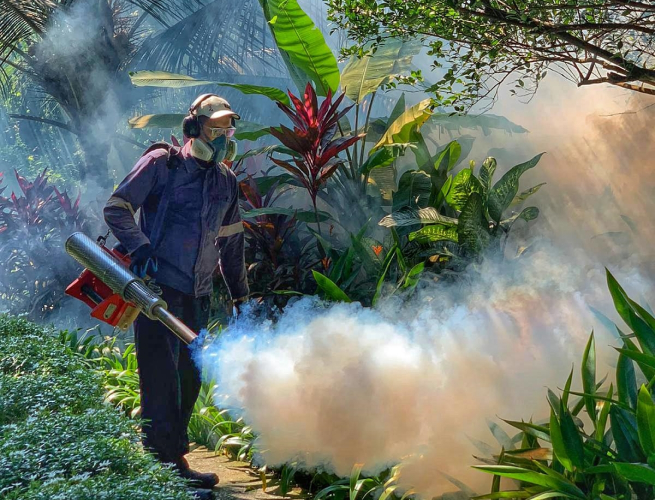
A trap captures selected mosquitoes over time. Fogging disperses insecticide to reduce adult mosquitoes that come into contact with the treatment.
Fogging therefore provides adult mosquito control rather than removing the breeding source.
NEA’s vector-control licensing conditions specifically state that fogging should be carried out only when necessary, reflecting the broader principle that it should not be treated as a universal or standalone mosquito solution.
Aardwolf provides water-based fogging for adult mosquito control as well as larviciding to target larvae at identified or potential breeding locations. Its technicians inspect external compounds for mosquito breeding before carrying out appropriate treatment.
The advantage of combining these measures is that adult and immature mosquitoes can be addressed at different stages of the life cycle.
What Is Mosquito Larviciding?
Larviciding targets mosquitoes while they are still developing in water.
When mosquito larvae are found in locations that cannot simply be emptied or eliminated immediately, professional treatment may involve applying an appropriate larvicide.
Aardwolf states that its technicians identify actual or prospective mosquito breeding locations before applying larvicide to suitable stagnant-water areas.
This approach differs from fogging because the objective is not to kill flying adults. It is to prevent larvae in the treated water from developing into adult mosquitoes.
Source removal remains preferable where stagnant water can simply be eliminated, while larviciding can support mosquito management in situations where water cannot be removed easily.
What Does Aardwolf Check Before Recommending Mosquito Treatment?
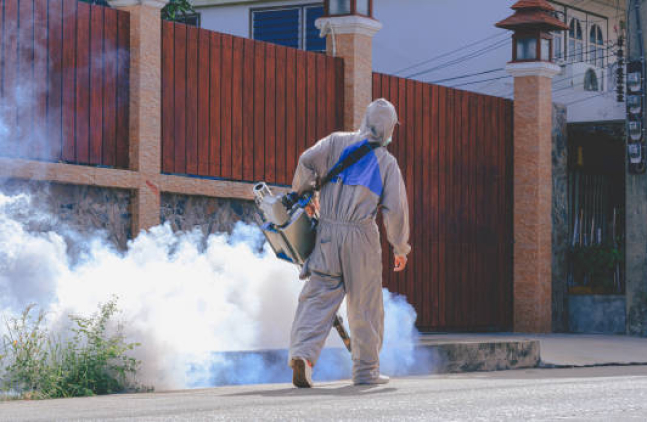
Aardwolf’s published mosquito-control process begins with inspection rather than immediately carrying out fogging.
The company states that technicians inspect external compounds and identify mosquito breeding or potential breeding locations before deciding on treatment. Suitable stagnant-water locations may then receive larvicide, while water-based fogging can be used to address existing adult mosquitoes. Aardwolf also lists misting among its mosquito-control services.
This distinction matters because repeated adult mosquito activity can have several explanations. Mosquitoes may be breeding within the property, entering from surrounding areas or resting in sheltered outdoor locations.
The inspection should therefore establish whether there is evidence of larvae or breeding water, where adult mosquitoes are being noticed and what environmental features could be supporting continued activity.
A trap may be useful as part of that environment, but professional mosquito management should not assume that purchasing more traps automatically addresses the source.
When Should You Call a Professional Mosquito Control Service?
Professional assessment becomes more useful when mosquito activity remains persistent after obvious stagnant water has been removed.
Repeated sightings of larvae, frequent bites, mosquito activity across a large outdoor compound or breeding risks in drains and service areas can all justify a more systematic inspection.
Commercial properties can also require professional support when mosquito management forms part of broader hygiene or vector-control responsibilities.
The important distinction is between seeing mosquitoes and understanding why mosquitoes continue to be present.
A professional assessment should identify breeding risks before selecting larviciding, fogging, misting or another suitable control measure.
What Should You Check Before Hiring a Mosquito Control Provider in Singapore?
Mosquito control falls within Singapore’s regulated vector-control industry.
NEA states that only companies registered as Vector Control Operators (VCOs) can be engaged to undertake vector-control work. Employees carrying out those services must also hold the appropriate Vector Control Technician licence or Vector Control Worker certification.
When comparing providers, NEA advises clients to consider trained manpower, experience, technologies, equipment and the company’s track record. Inspection findings and treatments should also be documented in service reports.
Thermal fogging carries additional operational requirements. NEA requires VCOs to notify the agency before thermal fogging is performed and to notify affected clients and surrounding premises in advance, including communicating relevant precautions.
A mosquito-control quotation should therefore explain more than the price. The provider should be able to describe what is being inspected, which treatment is proposed, why it is suitable and what follow-up is included.
Why Does Aardwolf Use More Than One Mosquito-Control Method?
Mosquitoes have several life stages, and one treatment does not necessarily address all of them.
Larviciding targets developing mosquitoes in suitable water. Fogging and misting target adult mosquitoes. Inspection identifies the environmental conditions allowing mosquito activity to continue.
Aardwolf currently provides these approaches as part of its mosquito-control service rather than presenting one treatment as a universal solution.
The company was established in Singapore on 8 April 1997 and states that its pest-management philosophy emphasises accurate problem identification and sustainable solutions.
For the property owner, the practical advantage of this approach is that the treatment can follow the conditions found at the premises rather than beginning with a predetermined fogging schedule or one consumer device.
Frequently Asked Questions About Mosquito Traps in Singapore
What Type of Mosquito Trap Works Best Against Aedes Mosquitoes?
There is no single consumer trap that guarantees Aedes control or dengue protection. NEA states that light-only traps are not effective for capturing Aedes aegypti, while host-seeking mosquitoes respond to cues including carbon dioxide, odour, colour, movement, heat and moisture. A trap designed around biologically relevant host-seeking or egg-laying cues is therefore more relevant than a simple UV light when Aedes is the concern, but breeding-source removal remains the priority.
Do Mosquito Traps Attract More Mosquitoes to My Home?
A trap is designed to attract or capture mosquitoes, but whether this increases bite risk depends on its design and placement. NEA states that its Gravitraps do not increase the mosquito population because egg-laying females are captured and adults cannot emerge from eggs laid inside. That finding relates specifically to the Gravitrap system and should not automatically be applied to every consumer mosquito trap.
Are Homemade Mosquito Traps Effective?
NEA states that the effectiveness of homemade mosquito traps is largely unproven because DIY attractants lack scientific validation. Water-based homemade traps can also become breeding habitats if they are poorly designed or maintained. Removing stagnant water is therefore more reliable for dengue prevention than depending on an unvalidated DIY trap.
Are UV Mosquito Traps Good for Dengue Prevention?
UV or light-only traps should not be relied upon for Aedes aegypti control. NEA states that light traps are more effective for certain night-active mosquitoes and are not effective for capturing predominantly daytime-biting Aedes aegypti. A trap full of insects therefore does not necessarily indicate meaningful dengue-vector control.
Where Should I Put a Mosquito Trap?
Placement depends on the trap design. Host-seeking, oviposition and passive traps work differently, so the manufacturer’s instructions should guide the location. NEA states that strategic placement and regular maintenance influence trap effectiveness. Sheltered locations, observed mosquito activity and access for maintenance may all be relevant depending on the device.
Is One Mosquito Trap Enough for a Landed Property?
A single trap is unlikely to address all mosquito activity across a large landed compound because gardens, drains, gutters, vegetation and outdoor containers can create multiple breeding or resting locations. The priority should be identifying and removing breeding sources throughout the property, with traps or professional control serving as additional measures.
Can a Mosquito Trap Replace Professional Mosquito Control?
Not necessarily. A mosquito trap mainly targets adult mosquitoes or assists with monitoring, depending on the design. Professional mosquito control may include inspection for breeding habitats, larviciding and appropriate adult-control treatments. Aardwolf’s current programme combines breeding-site inspection, larviciding, fogging and misting according to the conditions found.
How Often Should I Check My Home for Mosquito Breeding?
NEA advises residents to carry out the Mozzie Wipeout at least once a week. Potential breeding locations should be checked and stagnant water removed before mosquitoes can complete their development. This routine should continue even when mosquito traps, repellents or other control measures are already in use.
When Should I Contact Aardwolf Pestkare for Mosquito Control?
Professional assessment may be appropriate when mosquito activity remains persistent after obvious water sources have been removed, when larvae repeatedly appear or when the property contains drains, landscaping, external compounds or commercial service areas that are difficult to assess using household measures alone. Aardwolf provides breeding-site inspection, larviciding, fogging and misting according to the conditions identified at the premises.
Final Thoughts: Is a Mosquito Trap Worth Using in Singapore?
A mosquito trap can be useful in Singapore when it is chosen for the right purpose and used with realistic expectations.
The most important distinction is that not every trap targets Aedes aegypti effectively. NEA specifically states that light-based traps are not effective for capturing this predominantly daytime-biting mosquito, while host-seeking mosquitoes respond to cues such as carbon dioxide, scent, heat, moisture, colour and movement.
Oviposition traps operate differently by targeting females searching for somewhere to lay eggs, while passive fan traps capture mosquitoes that happen to pass nearby. Each design therefore solves a slightly different problem.
No trap removes the need for source control. NEA continues to identify removal of breeding habitats as the key to reducing mosquito populations and dengue risk because even effective traps must compete with people and natural breeding locations.
For homes and businesses, the practical approach is to remove stagnant water, reduce bite exposure, select traps according to the mosquito behaviour being targeted and investigate persistent mosquito activity rather than simply adding more devices.
Aardwolf Pestkare supports this layered approach through mosquito breeding-site inspection, larviciding and adult mosquito treatments such as fogging and misting where appropriate.
Rather than asking which single mosquito trap will completely solve the problem, the better question is: which combination of source reduction, trapping, bite prevention and professional treatment best addresses the mosquito activity around this particular property?